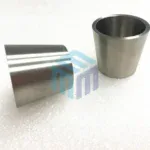


Tungsten crucibles are indispensable components in high-temperature metallurgical, semiconductor, and crystal growth processes. With an exceptional melting point of 3422 °C, outstanding thermal stability, and high chemical resistance in vacuum or inert atmospheres, these crucibles outperform most other refractory materials. Manufactured primarily through powder metallurgy techniques, tungsten crucibles combine dimensional stability, low thermal expansion, and high purity—making them ideal for applications such as Czochralski crystal growth, superalloy melting, rare-earth smelting, and nuclear fuel processing.
This article examines the manufacturing processes, physical properties, industrial applications, and selection criteria to help engineers and procurement managers choose the right tungsten crucible for their processes.
Tungsten crucibles offer several features and advantages that make them valuable in various high-temperature applications, especially in industries like metallurgy, electronics, and materials science.
What Are Tungsten Crucibles and How Are They Made?
Tungsten crucibles are fabricated from high-purity tungsten powder (>99.95%) to ensure minimal contamination in sensitive processes like semiconductor crystal growth.
The manufacturing process typically involves:
-
Powder Metallurgy Preparation – Ultra-fine tungsten powder is pressed into a crucible preform using isostatic or uniaxial pressing to achieve uniform density.
-
Sintering – The preform is sintered at 2200–2500 °C in a hydrogen or vacuum furnace, ensuring strong grain bonding and high mechanical integrity.
-
Hot Isostatic Pressing (HIP) – Optional HIP processing further improves density and eliminates residual porosity, enhancing thermal shock resistance.
-
Machining & Finishing – Precision CNC machining shapes the crucible, ensuring tight dimensional tolerances, smooth internal surfaces, and minimal stress concentrations.
-
Surface Treatments – Coatings such as hafnium carbide (HfC) or yttrium oxide (Y₂O₃) may be applied to enhance oxidation resistance and extend service life in oxygen-bearing atmospheres.
Compared to crucibles made from graphite, molybdenum, or alumina, tungsten crucibles retain structural integrity under prolonged exposure to extreme heat and corrosive melts.
Key Features and Advantages of Tungsten Crucibles:
- High Melting Point: Tungsten crucibles have an exceptionally high melting point of about 3422°C (6192°F), making tungsten crucibles suitable for processes that involve extreme temperatures, such as melting refractory metals, ceramics, and high-temperature alloys.
- Chemical Inertness: Tungsten is highly resistant to chemical attack by most acids, alkalis, and molten metals, providing excellent corrosion resistance. This property makes tungsten crucibles suitable for handling corrosive materials and reactive substances.
- Thermal Stability: Tungsten crucible exhibit excellent thermal stability, maintaining their structural integrity and dimensional stability even at high temperatures. This property is crucial for applications involving thermal cycling, rapid heating, and cooling.
- High Density: Tungsten has a high density, which allows tungsten crucibles to withstand mechanical stress and pressure during handling and processing operations. This density also contributes to their durability and resistance to deformation.
- Refractory Properties: Tungsten is classified as a refractory metal due to its ability to withstand high temperatures without softening or melting. Tungsten crucible are therefore used in high-temperature environments such as vacuum furnaces, sintering processes, and semiconductor manufacturing.
- Low Thermal Expansion: Tungsten has a low coefficient of thermal expansion, which means tungsten crucibles experience minimal dimensional changes with temperature variations. This property is beneficial for maintaining tight tolerances and preventing thermal stress-induced cracking.
- Compatibility with High Vacuum: Tungsten is compatible with high vacuum environments, making tungsten crucible suitable for applications requiring vacuum or inert gas atmospheres, such as thin-film deposition, electron beam melting, and plasma processes.
- Longevity and Reusability: Tungsten crucible are known for their longevity and reusability due to their robust construction and resistance to degradation at high temperatures. This characteristic helps reduce operational costs over time.
- Wide Range of Applications: Tungsten crucible find applications in diverse industries, including electronics, metallurgy, and research laboratories, where high-temperature processing, chemical resistance, and thermal stability are essential.
Overall, the features and advantages of tungsten crucible make them a preferred choice for demanding applications that require high performance under extreme conditions.
Top Industrial Applications of Tungsten Crucibles
Tungsten crucibles are used wherever thermal, chemical, and mechanical stability at extreme temperatures is required:
-
Semiconductor Single-Crystal Growth – Ideal for Czochralski (CZ) silicon, gallium arsenide (GaAs), and sapphire (Al₂O₃) crystal pulling processes due to their low thermal expansion and minimal contamination risk.
-
Superalloy and Refractory Metal Melting – Used for melting molybdenum, tantalum, rhenium, and nickel-based superalloys in vacuum or inert environments.
-
Rare-Earth Smelting – Effective for refining neodymium, dysprosium, and other rare-earth metals used in high-performance magnets and electronics.
-
Nuclear Fuel Processing – Suitable for sintering uranium dioxide pellets, plutonium compounds, and thorium-based fuel under protective atmospheres.
-
Vacuum Metallurgy & Electron Beam Melting (EBM) – Crucial in high-purity metal production and advanced additive manufacturing feedstock preparation.
In each of these fields, tungsten’s extreme melting point and chemical inertness prevent crucible failure where other materials degrade rapidly.
Choosing the Right Tungsten Crucible for Your Process
Selecting the correct tungsten crucible involves balancing material purity, manufacturing method, coating type, and cost against your process requirements:
-
Match Purity to Application – For semiconductor or crystal growth, use 99.95%+ purity tungsten to avoid trace contamination that could affect crystal quality.
-
Size & Wall Thickness – Larger crucibles with thicker walls improve durability but increase thermal gradients; optimize based on process thermal profile.
-
Atmosphere Conditions – In high-oxygen environments, opt for HfC or Y₂O₃ coatings to minimize oxidation and extend crucible lifespan.
-
Thermal Cycle Considerations – If rapid heating/cooling is involved, choose HIP-processed crucibles for better thermal shock resistance.
-
Supplier Capability & Quality Control – Partner with suppliers who offer tight tolerance machining, grain size certification, and full material traceability.
By considering these factors, engineers can maximize crucible service life while ensuring product quality and process efficiency.
Conclusion:
Tungsten crucibles stand out as a top choice for extreme temperature and corrosive environments, offering unmatched strength, durability, and thermal resistance. Their exceptional properties make them ideal for a wide range of applications in metallurgy, electronics, and scientific research. Whether you’re melting high-purity metals or conducting high-temperature experiments, tungsten crucibles deliver reliability and long service life.
Looking to source premium tungsten crucibles in the U.S.? M-Kube Enterprise is your trusted partner for advanced material solutions. Contact us at +1-732-808-1999 or info@mkubeenterprise.com for expert guidance and quality products tailored to your needs.