


Producing high-purity titanium dioxide (TiO₂) from molten salts requires crucibles that can endure aggressive chemical environments while maintaining dimensional stability at elevated temperatures. Traditional ceramic crucibles often suffer from corrosion, contamination, or wetting issues when exposed to molten chloride or fluoride salts used in TiO₂ electrochemical extraction and synthesis. This is where boron nitride (BN) crucibles excel. With their exceptional chemical inertness, high thermal conductivity, and non-wetting surface characteristics, BN crucibles provide a clean, stable environment for the molten salt process, ensuring both purity of the TiO₂ product and extended crucible life. In this blog, we will explore why boron nitride is uniquely suited for molten salt electrolysis, the advantages it brings over other refractory materials, and its role in enabling efficient and contamination-free production of titanium dioxide.
Why Boron Nitride Crucibles Are Ideal for Molten Salt Electrolysis
Boron nitride (BN) crucibles are highly valued in molten salt electrolysis due to their exceptional chemical inertness, high thermal stability, and non-wetting properties. BN remains stable at temperatures above 1000 °C in inert or reducing atmospheres and resists attack from molten salts, metals, and slags.
Its low electrical conductivity in solid form prevents unwanted short circuits, while excellent thermal shock resistance allows for repeated heating and cooling cycles without cracking. The non-reactive surface minimizes contamination of the molten product, ensuring higher purity yields.
These properties make BN crucibles a preferred choice for producing high-purity metals like aluminum, magnesium, and rare earth elements in electrolytic processes where both chemical compatibility and dimensional stability are critical.
Unique Material Properties: Boron Nitride Crucibles
Boron nitride (BN) offers a rare combination of properties that make it uniquely suited for molten salt electrolysis:
- High thermal conductivity and low thermal expansion reduce the risk of cracking during rapid temperature changes.
- Chemically inert with molten salts, preventing unwanted reactions.
- Non-wetting surface properties ensure easy material removal and minimal residue.
- Can withstand temperatures exceeding 1800°C, ideal for high-temperature electrochemical reactions.
Boron Nitride Crucibles Comparison to Other Crucible Materials
Comparison of boron nitride crucibles against other materials highlights their superior resistance to corrosion, thermal shock, and contamination.
| Crucible Material | Max Temp | Reactivity with Salts | Risk of Contamination | Cost |
|---|---|---|---|---|
| Boron Nitride (BN) | ~ 2300°C (in inert atmosphere) | Non-reactive | Very Low | High |
| Alumina (Al₂O₃) | ~1800°C | Moderate | Moderate | Medium |
| Graphite | >2800°C (in inert atmosphere) | Reacts with many salts | High | Medium |
| Zirconia (ZrO₂) | ~2200°C | Stable, but expensive | Low | Very High |
Unlike graphite or alumina, BN crucibles maintain the purity of the final TiO₂ product, which is critical for advanced material applications.
Role of Boron Nitride Crucibles in TiO₂ Synthesis from Molten Salt
In molten salt–based TiO₂ synthesis, crucible material plays a decisive role in maintaining product purity and process stability. Boron nitride (BN) crucibles are ideal because they exhibit outstanding chemical inertness toward chloride, fluoride, and nitrate salts typically used in molten salt reactions. Unlike graphite or metal crucibles, BN does not introduce carbon contamination or react with titanium precursors.
The Molten Salt Process
In this method, titanium precursors such as TiCl₄ or Ti metal are dissolved in molten salts like sodium chloride (NaCl), potassium chloride (KCl), or calcium chloride (CaCl₂). Through electrolysis or thermal treatment, titanium ions are converted to high-purity TiO₂.
Why Container Stability Matters
Using stable, inert crucibles ensures:
- No contamination from the crucible walls.
- No reaction between molten salt and container.
- Maximum yield and purity of TiO₂.
Boron nitride crucibles are critical in preserving product integrity in both lab and industrial-scale production.
Types and Sizes of Boron Nitride Crucibles for Lab and Industry
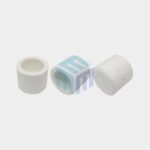
Boron nitride crucibles are available in shapes like cylindrical, conical, and rectangular forms, with sizes ranging from a few milliliters for lab-scale experiments to several liters for industrial production. Custom dimensions and wall thicknesses can be tailored to match specific thermal, chemical, and process requirements.
Standard and Small Boron Nitride Crucibles
Small-scale research applications benefit from:
- Small boron nitride crucibles that support rapid thermal cycling.
- Easy handling and precise temperature control for bench-top experiments.
These are ideal for university labs, materials science R&D, and experimental setups where sample size is limited.
Custom Boron Nitride Crucibles
For large-scale or specialized operations, custom boron nitride crucibles are available:
- Tailored shapes (cylindrical, square, tapered)
- Optional coatings to enhance durability
- Custom dimensions to fit specific reactors
Applications of Boron Nitride Crucibles in TiO₂ Production
BN crucibles are increasingly favored in molten salt processes involving TiO₂ because of the combination of chemical inertness, thermal stability, and non-wetting behavior. Below are key roles and advantages:
- Maintaining High Purity in TiO₂ / Titanium Metal Extraction
One of the primary challenges in molten salt electrolysis or thermal synthesis is contamination from crucible materials. BN is chemically inert toward many molten salts, metal oxides, and molten metals, helping prevent leaching or diffusion of impurities into the Ti/TiO₂ product.
Since BN doesn’t react with most chlorides, fluorides, or oxide melts, it helps preserve the chemical purity needed for high-end applications (e.g. electronics).
- Thermal Stability & Resistance to Thermal Shock
BN crucibles can withstand high temperatures, especially under inert or non-oxidizing atmospheres, which are common in molten salt processes.
Their low coefficient of thermal expansion reduces stress during heating and cooling cycles, decreasing the risk of cracking.
This makes BN ideal in repeated cycle operations or fluctuating temperature processes.
- Non-Wetting / Self-Cleaning Surfaces
BN exhibits low wettability toward molten salts and molten metals. That means the melt does not cling or wet the crucible walls strongly.
As a result:
- It’s easier to remove the solidified TiO₂ or metal product.
- Residues and adhering slag are minimized.
- The lifetime of the crucible is extended because adhesion and corrosion are less severe.
- Electrical Insulation & Safety in Electrolysis
In electrochemical setups, it is crucial that the crucible doesn’t conduct current or create unintended paths. BN is electrically insulating, helping to keep the electrolysis circuit controlled and safe.
- Comparative Advantages Over Alternative Crucible Materials
| Material | Advantages | Limitations in TiO₂ / Molten Salt Context |
|---|---|---|
| BN (Boron Nitride) | Chemical inertness, non-wetting, thermal stability, low expansion | Cost, fabrication complexity |
| Alumina (Al₂O₃) | Low cost, common | Reacts or degrades in molten salts; possible contamination |
| Graphite / Carbon | Good thermal conductivity | Oxidation in non-inert atmospheres; carbon contamination |
| Zirconia (ZrO₂) | High stability | Larger thermal expansion, more prone to cracking under thermal cycling |
Because of these advantages, many researchers and manufacturers prefer BN crucibles for molten salt processes involving TiO₂ and related materials.
Moreover, BN is machinable (like graphite), allowing custom shapes and sizes to suit specific reactor geometries.
Factors to Consider When Choosing a BN Crucible for TiO₂ Processing
When selecting a crucible for TiO₂ processing, consider chemical compatibility with molten salts, thermal stability at synthesis temperatures, and non-wettability to prevent product adhesion. Purity of the crucible material is also crucial to avoid contamination.
Crucible Volume and Wall Thickness
- Thicker walls provide better thermal insulation and longer lifespan.
- Thinner walls heat faster but are more prone to thermal stress.
- Choose a balance depending on your heating profile and processing needs.
Purity and Grain Structure
- Opt for high-purity BN (≥99.5%) to avoid impurities in TiO₂ output.
- Fine-grained or hot-pressed BN provides higher mechanical strength and smoother surfaces.
Where to Find Quality Boron Nitride Crucibles
Quality boron nitride crucibles can be sourced from specialty ceramic manufacturers, high-temperature lab equipment suppliers, and advanced materials distributors. Look for vendors offering material purity certifications, custom fabrication, and proven track records in supplying crucibles for molten salt and high-purity applications.
Boron Nitride Crucibles for Sale: What to Look For
When shopping for boron nitride crucibles for sale, evaluate:
- High-temperature ratings
- BN purity and density
- Precision in inner diameter and wall thickness
- Customization capabilities
Choosing a Reliable Boron Nitride Crucible Supplier
Partner with a boron nitride crucible supplier that offers:
- On-time delivery within the US
- Clear documentation (e.g., material datasheets, RoHS compliance)
- Responsive customer support for custom requirements
Troubleshooting Common Issues with BN Crucibles
Even though BN crucibles offer many benefits, failures or performance degradation can still occur. Here are common issues, causes, symptoms, and mitigation strategies:
- Cracking or Fracture Due to Thermal Stress
Cause: Rapid heating or cooling (thermal shock), especially if the crucible has nonuniform temperature zones or if the crucible is constrained by supports or reactor geometry.
Symptom: Cracks, chips, delamination, partial breakage.
Mitigation:
- Use controlled temperature ramp rates (avoid fast changes).
- Ensure crucible mounting allows for expansion.
- Preheat parts or use gradual heating steps.
- Use crucibles with sufficient wall thickness to withstand gradients.
- Erosion or Corrosive Attack at High Temperatures
Cause: Prolonged exposure to aggressive molten salts or reactive species (chloride, fluoride, halides) may slowly degrade the BN surface, especially under extreme temperature or in presence of contaminants. Some studies show that even pyrolytic BN coatings can resist fluoride salts under certain conditions.
Symptom: Surface pitting, thinning of walls, roughening, weight loss.
Mitigation:
- Shield the crucible from direct contact with highly aggressive species, or use lining strategies.
- Periodically inspect and replace before severe damage.
- Wetting or Adhesion in Some Salt-Melt Conditions
Cause: Under certain melt chemistries, or if the BN surface is contaminated, molten salts or slags might wet or adhere more strongly than intended.
Symptom: Difficulty in extracting solidified TiO₂ product, residues stuck to walls, higher cleaning effort.
Mitigation:
- Keep the crucible surface clean and free of contaminants.
- Use non-wetting coatings or treatments if compatible.
- Design crucible geometry to minimize contact area or promote release.
- Mechanical Damage During Handling
Cause: BN is ceramic-like; impacts, bumps, or mishandling can cause chipping.
Symptom: Chips, fractures, degraded sealing or fit, misalignment.
Mitigation:
- Use proper handling tools (soft supports, cushioned holders).
- Avoid dropping, contact with harder materials.
- Inspect before each run.
- Insufficient Purity or Material Defects
Cause: Lower-grade BN may contain impurities or binder residues; defects in microstructure can act as stress concentrators.
Symptom: Early failure, unexpected corrosion spots, cracks.
Mitigation:
- Source high-quality BN with documentation (datasheets, purity).
- Pre-burn or condition new crucibles to remove volatiles or residual binder.
- Quality-check batches (e.g. microscopic inspection) before use.
- Overheating in Oxidizing Atmospheres
Cause: BN will oxidize slowly in the presence of oxygen at high temperatures beyond its stability limit in air (≈ 900 °C for oxidizing atmospheres)
Symptom: Surface oxidation, discoloration, weight loss.
Mitigation:
- Operate in inert or reducing atmospheres when running above safe limits in air.
- Avoid exposing BN to high temperatures in open air unless designed for it.
- Use protective gas atmospheres or vacuum if required.
Maintenance, Handling, and Storage Tips: Boron Nitride Crucible
Handle boron nitride crucibles with care to avoid mechanical damage, using gloves and cushioned supports. Store them in a dry, vibration-free environment and clean gently with soft brushes or solvents to prevent contamination. Avoid rapid temperature changes to minimize thermal shock.
Best Practices for Long-Term Use
- Avoid sudden thermal changes to reduce cracking risk.
- Never use metal scrapers; use soft brushes to remove residue.
- After each use, allow the crucible to cool naturally to room temperature before handling.
Proper Storage
- Keep crucibles in a dry, dust-free environment.
- For small boron nitride crucibles, use foam-lined containers to prevent chipping during transport or storage.
Conclusion
Boron nitride crucibles have emerged as a critical enabler in the molten salt route for producing high-purity TiO₂. Their unique combination of chemical inertness, non-wetting behavior, and stability at extreme temperatures ensures minimal contamination and long service life compared to conventional crucible materials. By providing a clean reaction environment and resisting aggressive chloride and fluoride salts, BN crucibles not only improve the efficiency of TiO₂ synthesis but also enhance the reliability of large-scale industrial operations. As demand grows for advanced materials in energy, electronics, and coatings, boron nitride crucibles will continue to play a pivotal role in advancing molten salt technologies and ensuring consistent, high-quality TiO₂ production.
Contact us at 📧 info@mkubeenterprise.com or 📞 +1-732-808-1999 to get expert advice