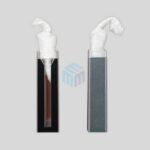

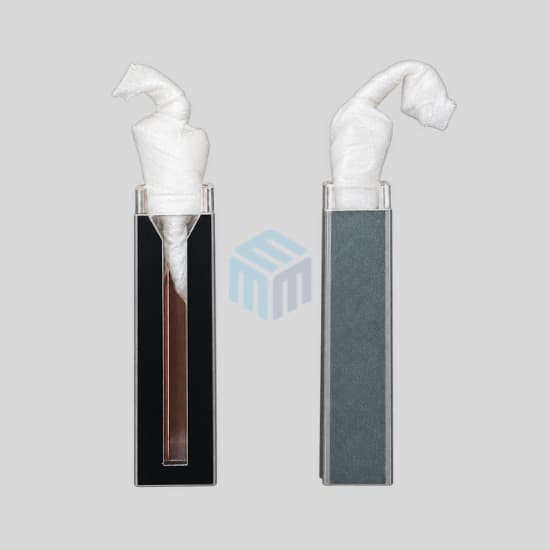
UV-Vis spectroscopy is widely used in pharmaceutical research, biotechnology, food testing, environmental analysis, chemistry, and quality control. The spectrophotometer cuvettes used in these measurements can directly affect sample consumption, handling, and measurement consistency. When sample availability is limited, choosing between semi micro cuvettes and standard cuvettes becomes especially important. Both can be designed with a 10 mm optical path length, but their physical dimensions and required sample volumes can differ significantly.
For laboratories working with expensive, rare, or difficult-to-obtain samples, a cuvette semi micro design can reduce sample consumption while maintaining compatibility with many standard UV-Vis spectrophotometers. However, standard cuvettes may remain preferable for routine testing when sufficient sample volume is available.
This guide explains the differences between semi-micro and standard spectrophotometer cells, including volume, optical materials, black walls, PTFE closures, applications, and selection considerations.
What Are Standard Spectrophotometer Cuvettes?
Standard spectrophotometer cuvettes are commonly used rectangular cells designed for routine spectrophotometric measurements. Many standard designs use a 10 mm path length and are compatible with conventional spectrophotometer cell holders.
Standard cuvettes are available in materials such as optical glass, quartz, and certain plastics. For UV measurements, a uv vis quartz cuvette or uv quartz cuvette is generally selected when transmission in the ultraviolet range is required.
Standard cells can also be supplied in different configurations, including:
- Standard cell with lid
- Standard cell with PTFE stopper
- Round-bottom designs
- Quartz cells for UV-Vis measurements
- Glass cells for suitable visible-range applications
- Custom optical path lengths
A standard quartz cell may require more sample than a semi-micro design because of its larger internal volume.
What Are Semi-Micro Cuvettes?
Semi micro cuvettes are designed to reduce the amount of sample required for spectrophotometric analysis while retaining a format that can work with standard instrument holders.
A semi micro cell typically has a narrower internal sample chamber than a conventional cuvette. This allows the required liquid volume to be reduced while maintaining an appropriate optical path through the sample.
For example, commercially available semi-micro cells can have capacities around 1.5 mL, while some specialized quartz semi-micro designs can use approximately 1,000 µL or other lower volumes depending on their geometry.
The exact semi micro cuvette volume depends on the manufacturer, optical path length, chamber dimensions, and minimum filling requirements.
Semi-Micro vs Standard Cuvettes: Key Differences
The main difference is not necessarily the optical path length. Instead, it is the amount of sample required to fill the optical region adequately.
| Feature | Standard Cuvette | Semi-Micro Cuvette |
| Typical use | Routine laboratory analysis | Limited-volume samples |
| Sample requirement | Higher | Lower |
| Common path length | 10 mm | 10 mm |
| Internal chamber | Larger | Narrower |
| Sample conservation | Moderate | Better |
| UV-compatible versions | Available | Available |
| Quartz versions | Available | Available |
| PTFE closure options | Available | Available |
| Black-wall versions | Available | Available |
| Best suited for | Routine testing | Research and low-volume testing |
Actual volumes vary considerably by design. For example, Fisher Scientific lists a 1.5 mL semi-micro cell and a 4.5 mL standard cuvette in one product family, both with a 10 mm path length.
This illustrates an important point: changing from a standard to a semi-micro cuvette can reduce sample consumption without necessarily changing the optical path length.
Why Sample Volume Matters in UV-Vis Analysis
Sample volume can be an important consideration when working with:
- Expensive reagents
- Limited biological samples
- Pharmaceutical development samples
- Protein and nucleic-acid solutions
- Research samples available only in small quantities
- High-value chemical compounds
- Samples requiring repeated measurements
Using a large-volume cuvette when only a small quantity of sample is available can result in unnecessary sample consumption.
A semi-micro cell can help laboratories perform measurements with less material. Some manufacturers specifically describe semi-micro designs as a way to scale down assay volumes and reduce reagent consumption.
Are Semi-Micro Cuvettes Suitable for UV Measurements?
Yes, but the optical material must be selected according to the wavelength range.
For UV-Vis spectroscopy, quartz cuvettes for spectrophotometer applications are commonly selected because quartz provides broad UV transmission.
The material should always be matched to the intended wavelength range. For example, one manufacturer lists quartz absorption cells with transmission extending from the far ultraviolet through the infrared, while plastic semi-micro products may have more restricted wavelength ranges depending on the polymer.
Therefore, simply choosing a semi-micro geometry is not enough. Laboratories should evaluate:
- Required wavelength range
- Sample volume
- Optical path length
- Chemical compatibility
- Instrument holder compatibility
- Required measurement accuracy
Semi-Micro Cell With Black Walls: When Is It Useful?
A semi micro cell with black walls is useful when stray light or unwanted transmission through the sides of the cuvette needs to be minimized.
Black side walls can help prevent light from passing through areas that are not intended to contribute to the measurement. This can be particularly useful for fluorescence-related measurements and samples where the optical background needs careful control.
Black-wall designs are available in specialized cuvette configurations.
The choice between transparent and black-wall construction should therefore depend on the instrument configuration and measurement technique rather than sample volume alone.
Semi-Micro Cell With PTFE Stopper vs Standard Cell With PTFE Stopper
A semi micro cell with PTFE stopper can provide a practical solution when sample containment is important.
PTFE is commonly used for closures because of its chemical resistance and suitability for laboratory applications. A stopper can also help reduce contamination, evaporation, and accidental sample loss during handling.
Similarly, a standard cell with PTFE stopper can be useful for routine measurements where the sample needs to remain covered.
The choice between the two depends mainly on:
- Required sample volume
- Internal cell dimensions
- Chemical compatibility
- Instrument holder requirements
- Need for sample containment
For volatile, reactive, or contamination-sensitive samples, the closure design should be considered alongside the optical material.
What About Round Bottom Standard Cells?
A round bottom standard cell is another configuration available for specific laboratory applications.
The rounded base can be useful for particular sample-handling requirements, but laboratories should verify that the cell geometry is compatible with the spectrophotometer’s holder and optical alignment.
For routine UV-Vis measurements, the most important factors remain the optical path, material, sample volume, and compatibility with the instrument.
When Should You Choose Semi-Micro Cuvettes?
A semi-micro cell is generally worth considering when sample volume is limited.
Typical situations include:
- Limited research samples
If only a small amount of sample is available, reducing the required fill volume can preserve material for additional testing.
- Expensive reagents
Reducing assay volume can help decrease reagent consumption, particularly when repeated measurements are required.
- Pharmaceutical and biotechnology research
Early-stage development often involves samples that may not be available in large quantities.
- Protein and nucleic-acid analysis
Small-volume measurements can be useful when sample preparation yields limited quantities.
- High-value chemical analysis
When sample preparation is expensive or time-consuming, using an appropriately sized cuvette can reduce unnecessary consumption.
Commercial examples demonstrate that semi-micro formats can be supplied specifically for lower-volume applications while retaining a 10 mm path length.
When Are Standard Cuvettes the Better Choice?
Standard cuvettes can remain the practical choice when sample volume is not a major limitation.
They may be preferable for:
- Routine quality-control testing
- High-throughput laboratory work
- Samples that are readily available
- General visible spectroscopy
- Applications using established standard operating procedures
- Laboratories with standardized cuvette handling systems
Standard cells can also provide greater flexibility when larger sample volumes are routinely required.
How to Choose the Right Cuvette for Low-Volume UV-Vis Analysis
Before selecting between standard and semi-micro spectrophotometer cells, consider these factors:
- Determine the minimum available sample volume
Start with the actual amount of sample available rather than selecting a cuvette based only on its external dimensions.
- Confirm the optical path length
A 10 mm path length is common, but other path lengths may be appropriate for specialized measurements.
- Select the correct optical material
For UV measurements, quartz is often appropriate. For visible-only measurements, glass or suitable optical plastics may provide a practical alternative.
- Check the instrument holder
Make sure the external dimensions and center height of the cuvette are compatible with the spectrophotometer.
- Consider a stopper or lid
For sensitive or volatile samples, a standard cell with lid or semi micro cell with PTFE stopper may provide better handling.
- Consider black-wall construction
For applications sensitive to stray light or unwanted optical transmission, a semi micro cell with black walls may be appropriate.
- Check chemical compatibility
The cuvette material and closure should be compatible with the solvents, acids, bases, buffers, and samples being analyzed.
What Should You Ask a Spectrophotometer Cuvettes Supplier?
When contacting a spectrophotometer cuvettes supplier or semi micro cuvettes supplier, provide the following information:
- Spectrophotometer model
- Required wavelength range
- Required path length
- Minimum sample volume
- Preferred material
- Required dimensions
- Optical windows
- Black-wall requirement
- Lid or stopper requirement
- PTFE stopper requirement
- Disposable or reusable preference
- Quantity required
- Any custom dimensions
Providing these details allows the supplier to recommend a configuration that matches both the sample and instrument.
Conclusion
Choosing between semi micro cuvettes and standard spectrophotometer cuvettes depends primarily on sample availability, wavelength range, optical material, instrument compatibility, and application requirements.
For low-volume UV-Vis analysis, a properly designed cuvette semi micro can reduce sample consumption while maintaining the required optical path. Quartz versions are suitable for applications requiring UV transmission, while black-wall, lid, and PTFE stopper configurations can address specialized handling and optical requirements.
Standard cuvettes remain useful for routine testing where sample volume is readily available. Rather than choosing solely by cuvette size, laboratories should evaluate the complete combination of sample volume, path length, material, dimensions, and instrument compatibility.
Looking for Semi-Micro or Standard Cuvettes?
M-Kube supplies a wide range of spectrophotometer cuvettes, including standard cells, uv vis quartz cuvettes, semi-micro cells, black-wall configurations, PTFE stopper options, round-bottom cells, and customized cuvette solutions.
📞 Call us: +1-732-808-1999 📧 Email: info@mkubeenterprise.com to discuss your required wavelength range, sample volume, path length, material, dimensions, and closure configuration. Our team can help identify a suitable cuvette configuration for your UV-Vis spectroscopy requirements.