
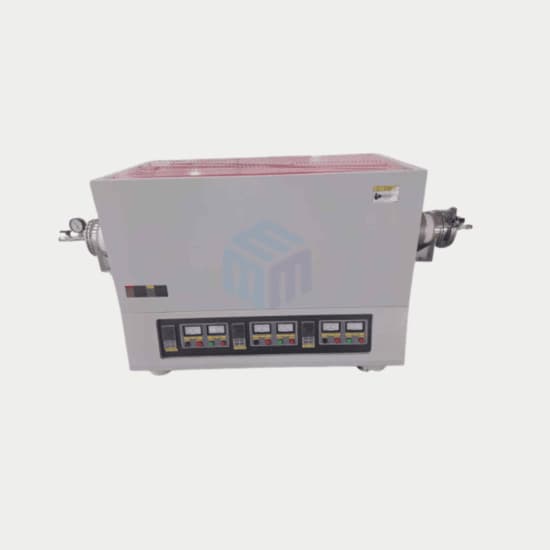
Choosing the right tube furnace isn’t just about temperature rating or size—it’s about control, uniformity, and application fit. One of the most common questions engineers and lab managers face is whether to use a single-zone or multi-zone tube furnace.
Both designs are widely used in laboratory tube furnaces, pilot-scale R&D, and industrial thermal processing. But selecting the wrong configuration can lead to temperature gradients, inconsistent results, or unnecessary cost. Let’s break down how these two furnace types differ and which one makes sense for your application.
What Is a Single-Zone Tube Furnace?
A single-zone tube furnace uses one heating zone controlled by a single temperature controller. Heat is applied uniformly from one central element, making it a straightforward and cost-effective solution.
Single-zone designs are commonly found in:
- Small tube furnaces
- Academic and research labs
- Routine heat treatment processes
- Entry-level lab tube furnace setups
They are available in horizontal tube furnace and vertical tube furnace configurations and are often paired with quartz tube furnaces for clean, high-temperature processing.
Advantages of Single-Zone Tube Furnaces
Single-zone tube furnaces are popular because they are:
- Simple to operate and maintain
- More affordable when comparing tube furnace price
- Ideal for uniform samples with limited length
- Suitable for sintering, annealing, and calcination
For labs performing standardized thermal treatments or material screening, a single-zone furnace often delivers reliable performance without unnecessary complexity.
Limitations of Single-Zone Tube Furnaces
The main limitation is temperature uniformity across longer tubes. Heat is most consistent at the center of the hot zone, with temperature drop-off toward the ends.
This can be a concern when:
- Processing long samples
- Requiring precise thermal gradients
- Performing gas-phase reactions sensitive to temperature variation
In such cases, a more advanced configuration may be required.
What Is a Multi-Zone Tube Furnace?
A multi-zone tube furnace uses two or more independently controlled heating zones along the length of the tube. Each zone can be programmed separately to fine-tune the temperature profile.
These systems are commonly used in:
- High temperature tube furnace applications
- Semiconductor processing
- Advanced material synthesis
- Industrial continuous processing
Multi-zone furnaces are often specified for demanding R&D environments and scaled-up industrial operations where precision is critical.
Advantages of Multi-Zone Tube Furnaces
Multi-zone designs offer key performance benefits:
- Superior temperature uniformity across long tubes
- Ability to create controlled thermal gradients
- Reduced edge cooling effects
- Higher reproducibility in sensitive processes
For applications like CVD, diffusion studies, and crystal growth, multi-zone tube furnaces provide a level of thermal control that single-zone systems cannot match.
Trade-Offs to Consider with Multi-Zone Furnaces
While performance improves, there are trade-offs:
- Higher upfront tube furnace price
- More complex control systems
- Slightly higher maintenance requirements
However, for precision-driven labs and industrial production lines, these costs are often justified by improved process control and yield.
Single-Zone vs Multi-Zone: Which One Should You Choose?
Choose a Single-Zone Tube Furnace If:
- You work with short or uniform samples
- Your application tolerates minor temperature variation
- You need a compact or small tube furnace
- Budget and simplicity are priorities
Choose a Multi-Zone Tube Furnace If:
- You need tight temperature uniformity across long tubes
- Your process is sensitive to thermal gradients
- You perform advanced synthesis or scale-up work
- You want flexibility for future applications
Both configurations are available in horizontal and vertical tube furnace designs and can be paired with quartz tube furnaces for clean, high-purity processing environments.
Conclusion
Choosing between a single-zone and multi-zone tube furnace comes down to your process sensitivity, sample size, and control requirements. Single-zone furnaces deliver simplicity and value, while multi-zone systems offer precision and flexibility for advanced applications.
By understanding your thermal profile needs today—and anticipating future requirements—you can select a tube furnace that supports accurate results, operational efficiency, and long-term scalability.
Do you need a laboratory tube furnace, high-temperature tube furnace, or a quartz tube furnace tailored to your application?
📞 Call us: +1-732-808-1999
📧 Email: info@mkubeenterprise.com
👉 Contact M-Kube Enterprise LLC today to discuss single-zone or multi-zone tube furnace options for your lab or industrial process.