
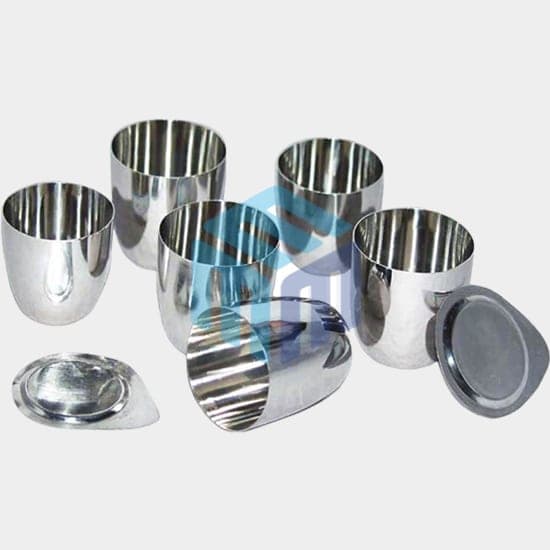
Crystal growth requires precise temperature control, stable materials, and carefully selected equipment. Even a small change in furnace conditions can affect crystal quality and production results. One common challenge is crucible cracking, warping, or deformation during high-temperature processing. A tantalum crucible is valued for its high melting point, ductility, and suitability for certain high-temperature vacuum and controlled-atmosphere applications. However, tantalum is not immune to damage. Improper heating, chemical reactions, contamination, and mechanical stress can reduce its service life. Understanding why these problems occur helps US crystal growers, semiconductor researchers, and advanced materials manufacturers prevent equipment failures and improve process reliability.
Why Are Tantalum Crucibles Used in Crystal Growth?
Tantalum (Ta) is a refractory metal with a melting point of approximately 3,017°C (5,463°F). Its high melting point and useful mechanical properties make it suitable for selected crystal growth and materials-processing applications.
Key advantages include:
- High melting point: Supports elevated-temperature processing within qualified operating conditions.
- Good ductility: Allows fabrication into different crucible geometries.
- Vacuum compatibility: Suitable for certain high-temperature vacuum environments.
- Chemical resistance: Offers compatibility with selected materials under controlled conditions.
- Manufacturing flexibility: Can be fabricated into small laboratory vessels or larger specialized crucibles.
However, tantalum can react with oxygen, nitrogen, carbon, and certain molten materials at elevated temperatures. Therefore, chemical compatibility and furnace atmosphere are critical selection factors.
What Causes a Tantalum Crucible to Crack?
Cracking generally occurs when the crucible experiences excessive stress, material embrittlement, or chemical degradation.
Common Causes of Cracking
| Cause | What Happens | Potential Result |
| Rapid temperature changes | Uneven heating or cooling creates thermal stress | Distortion or cracking |
| Oxygen contamination | High-temperature oxidation changes surface properties | Material degradation and embrittlement |
| Nitrogen or hydrogen exposure | Interstitial absorption can change mechanical behavior | Reduced ductility and increased cracking risk |
| Chemical incompatibility | Molten materials react with tantalum | Corrosion, contamination, or localized damage |
| Mechanical handling | Scratches, dents, or excessive force introduce defects | Crack initiation during later use |
| Repeated thermal cycles | Existing damage and stresses accumulate | Progressive distortion or failure |
Unlike brittle ceramics, clean tantalum is normally ductile. When cracking occurs, contamination-induced embrittlement, chemical attack, or severe localized stress may be involved.
For this reason, identifying the failure mechanism is more useful than simply replacing the damaged crucible.
Why Does a Tantalum Crucible Deform at High Temperatures?
Deformation is different from cracking. A crucible may bend, sag, or lose its original shape without breaking.
At elevated temperatures, tantalum becomes more susceptible to time-dependent deformation under sustained mechanical loading, commonly called creep.
Several conditions can contribute:
Excessive operating temperature: High temperatures reduce mechanical strength and increase the risk of creep deformation.
Heavy material loads: Large molten charges place additional stress on the crucible walls and bottom.
Insufficient wall thickness: Thin walls may not provide adequate structural support during prolonged heating.
Improper furnace support: Uneven contact or unsupported sections can create localized deformation.
Extended holding periods: Long processing cycles allow creep strain to accumulate.
A tantalum crucible for crystal growth should therefore be evaluated for operating temperature, load, hold duration, and support arrangement rather than melting point alone.
How Does Tantalum Crucible Purity Affect Cracking and Deformation?
Material purity plays an important role in high-temperature performance.
A high purity tantalum crucible may reduce unwanted impurities entering sensitive crystal growth processes. However, purity alone does not guarantee resistance to deformation.
Trace oxygen, nitrogen, hydrogen, and carbon can affect tantalum’s mechanical behavior, particularly after elevated-temperature exposure.
Important Material Properties
| Property | Why It Matters |
| Chemical purity | Helps control contamination and unwanted reactions |
| Oxygen and nitrogen content | Influences ductility and embrittlement risk |
| Grain structure | Affects high-temperature deformation behavior |
| Wall thickness | Influences mechanical strength and thermal response |
| Surface condition | Scratches and defects may contribute to failure |
| Manufacturing method | Influences dimensional consistency and potential defects |
Buyers should request material certificates and relevant impurity specifications from their tantalum crucible supplier.
For demanding applications, evaluating the material’s processing history and high-temperature performance is also important.
How Do Furnace Atmosphere and Vacuum Conditions Affect Tantalum Crucible Life?
Furnace atmosphere can significantly influence tantalum performance.
A tantalum crucible for vacuum furnace applications must be selected according to temperature, vacuum level, residual gases, and material compatibility.
Tantalum can oxidize rapidly at elevated temperatures when exposed to oxygen. Nitrogen and carbon may also react with tantalum under certain processing conditions.
To reduce these risks:
- Use furnace conditions qualified for tantalum.
- Check vacuum system integrity and residual gas levels.
- Control moisture and oxygen contamination.
- Avoid incompatible furnace fixtures and contact materials.
- Follow validated heating and cooling procedures.
Vacuum processing does not automatically eliminate contamination. Residual gases, furnace components, and processed materials may still affect crucible performance.
Can Crucible Design Prevent Cracking and Deformation?
Crucible geometry and manufacturing quality influence mechanical performance.
A custom tantalum crucible can be designed around specific furnace dimensions, crystal growth requirements, and support conditions.
Important design considerations include:
Wall thickness: Must balance structural support, thermal response, and material consumption.
Bottom geometry: Appropriate support and smooth transitions help reduce concentrated mechanical stresses.
Crucible diameter: Larger diameters may increase susceptibility to sagging under heavy loads.
Manufacturing construction: A seamless tantalum crucible eliminates welded joints, which may be beneficial where weld integrity is a concern. However, seamless construction does not eliminate creep or contamination risks.
For laboratory research, a small tantalum crucible may offer easier handling and lower material consumption, provided its dimensions suit the experiment.
How Can You Prevent Tantalum Crucible Failure?
Preventing failure begins with matching crucible specifications to actual operating conditions.
Recommended practices include:
- Verify material compatibility: Confirm that the crystal growth material will not cause unacceptable reactions with tantalum.
- Control furnace atmosphere: Minimize oxygen, moisture, and other reactive contaminants.
- Use controlled thermal cycles: Avoid unnecessary temperature gradients and abrupt changes.
- Provide proper support: Prevent uneven loading and unsupported bottom sections.
- Inspect before reuse: Check for distortion, thinning, cracks, and surface damage.
- Maintain process records: Track temperature, hold time, loading, and crucible condition.
A tantalum lab crucible used for experimental research may require different handling procedures from a larger industrial crystal growth vessel.
Read also: How Tantalum Crucibles Resist Chemical Attack at High Temperatures
What Determines Tantalum Crucible Price?
When comparing tantalum crucible price, consider material specifications and long-term performance rather than purchase cost alone.
Pricing depends on material purity, dimensions, wall thickness, manufacturing method, custom machining, inspection requirements, and order quantity.
When reviewing tantalum crucibles for sale, request information about material certification, dimensional tolerances, and manufacturing quality.
A lower initial price may not offer the best value if premature deformation causes rejected crystal batches or additional equipment downtime.
Conclusion
Cracking and deformation during crystal growth are often linked to material contamination, high-temperature creep, chemical incompatibility, or unsuitable crucible design.
Selecting a properly specified tantalum crucible and controlling furnace conditions can help reduce these risks and support consistent crystal growth operations.
M-Kube Enterprise helps customers explore tantalum crucible options for laboratory research and specialized high-temperature applications. Share your operating temperature, furnace atmosphere, material requirements, and dimensions to discuss suitable crucible specifications.