
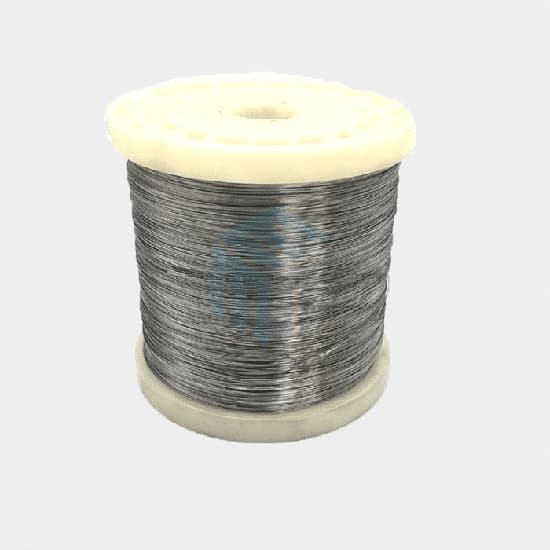
Titanium wire is widely used in applications where corrosion resistance, strength, low density, and long-term reliability are essential. From chemical processing and desalination equipment to marine systems, welding fabrication, heat exchangers, and industrial filtration, titanium can withstand environments that are challenging for many conventional metals. However, not all titanium wire grades provide exactly the same performance. Choosing the right grade is particularly important when the wire will be exposed to acids, chlorides, seawater, elevated temperatures, or welding conditions.
Commercially pure titanium grades such as Grade 1 and Grade 2 are commonly selected for corrosion-resistant applications, while alloyed grades can provide additional strength or enhanced resistance in specific environments.
In this guide, we’ll explain how to select the appropriate titanium wire grade for acid, chloride, and seawater environments and what to consider when purchasing titanium wire for industrial or fabrication applications.
Understanding Titanium Wire Grades
Before selecting titanium wire for sale, it is important to understand the difference between commercially pure titanium and titanium alloys.
Grade 1 Titanium Wire
Grade 1 is a commercially pure titanium grade with relatively low strength and excellent ductility.
It may be appropriate when the application prioritizes:
- Formability
- Corrosion resistance
- Low-to-moderate strength
- Welding
- Easy fabrication
Grade 1 can be considered for certain chemical and marine applications where high mechanical strength is not the primary requirement.
Grade 2 Titanium Wire
Grade 2 is one of the most widely used commercially pure titanium grades for industrial corrosion-resistant applications.
It offers an excellent balance of:
- Corrosion resistance
- Strength
- Ductility
- Weldability
- Availability
For many seawater and chloride applications, Grade 2 titanium wire is a practical starting point.
Grade 7 Titanium Wire
Grade 7 is titanium with a small palladium addition.
The palladium improves corrosion resistance in certain reducing and acidic environments.
This makes Grade 7 worth considering when the application involves:
- More aggressive chemical conditions
- Reducing acids
- Elevated corrosion risk
- Specialized chemical processing
However, the correct grade should always be selected based on the exact chemical composition, temperature, concentration, and operating conditions.
Grade 12 Titanium Wire
Grade 12 contains nickel and molybdenum additions and provides enhanced corrosion resistance and strength in specific environments.
It can be particularly valuable when processing conditions involve:
- Chlorides
- Brines
- Elevated temperatures
- Reducing environments
- More demanding chemical conditions
Technical information shows improved crevice-corrosion performance for Grade 12 compared with Grade 2 in certain saturated NaCl conditions.
Choosing Titanium Wire for Seawater Applications
Seawater contains significant chloride concentrations, making chloride corrosion resistance essential.
Commercially pure titanium is highly resistant to general corrosion in seawater. The pure titanium Grades 1, 2, and 3 are resistant to general corrosion in seawater to elevated temperatures, with alloyed grades providing additional protection where higher temperatures or crevice conditions require it.
Grade 2 is often a strong choice for:
- Marine fabrication
- Desalination systems
- Seawater heat exchangers
- Marine filtration
- Piping systems
- Welding applications
Where higher temperature or more severe crevice conditions are present, an alloyed grade such as Grade 12 may warrant consideration.
Choosing Titanium Wire for Chloride Environments
Chloride-containing environments can cause localized corrosion in many metals.
Titanium generally performs exceptionally well because of its stable passive oxide film.
However, design factors still matter.
Consider:
- Chloride concentration
- Temperature
- pH
- Oxygen availability
- Crevice geometry
- Flow conditions
- Galvanic coupling
For example, pure titanium has strong resistance to seawater corrosion, while alloy additions can improve resistance when higher temperatures or difficult crevice conditions are encountered.
Therefore, simply selecting the most expensive grade is not necessarily the best approach. The wire grade should match the actual process environment.
Choosing Titanium Wire for Acid Applications
Acid service requires more careful grade selection because titanium’s performance varies with acid chemistry and operating conditions.
Titanium demonstrates excellent resistance to many oxidizing acids and several organic acids. However, strongly reducing acids and certain combinations of temperature, concentration, and chemistry may require alloyed titanium grades.
For demanding chemical environments, Grade 7 or Grade 12 may be considered depending on the specific process.
Always evaluate the actual acid, concentration, temperature, and exposure conditions before selecting the wire grade.
This is particularly important for applications involving:
- Hydrochloric acid
- Sulfuric acid
- Nitric acid
- Organic acids
- Mixed-acid environments
Titanium’s corrosion resistance is highly environment-dependent, so material compatibility data should be reviewed for the exact service conditions.
Titanium TIG Wire for Corrosion-Resistant Welding
One of the most important applications for titanium wire is welding.
Titanium TIG wire is used as a filler material in gas tungsten arc welding (GTAW/TIG) of titanium components.
For successful titanium welding, proper shielding is critical.
Weld areas need effective protection from atmospheric contamination because titanium can react with oxygen, nitrogen, and hydrogen at elevated temperatures.
Proper welding practices help prevent:
- Embrittlement
- Weld contamination
- Reduced ductility
- Premature failure
For demanding fabrication work, selecting the correct titanium TIG wire grade to match the base metal is essential.
18 Gauge Titanium Wire: What Does It Mean?
18 gauge titanium wire refers to a particular wire diameter specification rather than a titanium material grade.
This distinction is important.
Gauge identifies the physical size of the wire, while the titanium grade identifies its chemical composition and performance characteristics.
When purchasing 18 gauge wire, confirm:
- Titanium grade
- Actual wire diameter
- Purity
- Temper or condition
- Surface finish
- Application requirements
An 18 gauge Grade 2 wire and an 18 gauge titanium alloy wire may have the same approximate physical size but very different material properties.
Titanium Wire Mesh Applications
Titanium wire mesh is produced by weaving or welding titanium wire into a mesh structure.
It is commonly used for:
- Chemical filtration
- Marine filtration
- Electrochemical applications
- Anode systems
- Screening
- Corrosion-resistant filtration
- Laboratory equipment
Titanium’s corrosion resistance makes it particularly valuable where stainless steel or other conventional mesh materials may degrade.
When selecting titanium mesh, consider both the wire grade and mesh construction.
Pure Titanium Wire vs Titanium Alloy Wire
The choice between pure titanium wire and titanium alloy wire depends on the application.
Pure Titanium Wire
Advantages include:
- Excellent corrosion resistance
- Excellent weldability
- Good ductility
- Strong seawater performance
It is particularly attractive for corrosion-focused applications.
Titanium Alloy Wire
Titanium alloys can provide:
- Higher strength
- Improved mechanical performance
- Specialized corrosion resistance
- Better performance in selected demanding environments
For example, Grade 5 titanium provides substantially higher strength than commercially pure grades, but it should not automatically be assumed to be the best option for every corrosive application.
Choosing the Right Titanium Wire Supplier
When evaluating titanium wire suppliers, look for:
- Clearly identified titanium grades
- Material certifications
- Consistent wire diameter
- Quality surface finish
- Appropriate packaging
- Traceability
- Custom sizing capabilities
For welding applications, confirm that the wire meets the appropriate welding-material specification.
Conclusion
Choosing the right titanium wire for acid, chloride, and seawater environments requires more than simply selecting a corrosion-resistant metal. The titanium grade, operating temperature, chemical concentration, chloride exposure, mechanical requirements, and fabrication method all influence long-term performance.
For many marine and seawater applications, commercially pure Grade 2 titanium provides an excellent balance of corrosion resistance, strength, and weldability. For more aggressive chemical or elevated-temperature environments, alloyed grades such as Grade 7 or Grade 12 may provide additional performance advantages.
Whether you need pure titanium wire, titanium alloy wire, titanium TIG wire, titanium wire mesh, or titanium wire rope, selecting the correct grade and working with an experienced supplier can help maximize service life and minimize corrosion-related maintenance.
Looking for High-Quality Titanium Wire?
M-Kube Enterprise LLC supplies titanium wire, titanium TIG wire, pure titanium wire, titanium alloy wire, titanium wire mesh, and other titanium products for demanding industrial, marine, chemical processing, welding, and laboratory applications.
Whether you need titanium wire price, 18 gauge titanium wire, a custom titanium wire spool, or corrosion-resistant titanium wire for seawater and chloride environments, our team can help you identify the appropriate material and configuration.
📞 Call us: +1-732-808-1999
📧 Email: info@mkubeenterprise.com today for titanium wire specifications, availability, custom requirements, and pricing.