
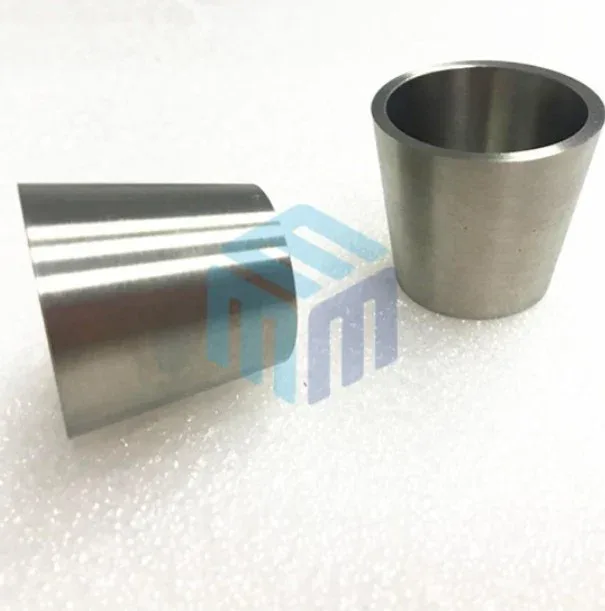
Sapphire crystal growth is one of the most demanding high-temperature manufacturing processes in the advanced materials industry. Used extensively in LED substrates, semiconductor devices, optical components, aerospace systems, and consumer electronics, sapphire crystals require precise temperature control and exceptionally stable processing environments during production. At the heart of many sapphire growth systems is the crucible. The choice of crucible material directly affects crystal quality, production efficiency, contamination levels, equipment lifespan, and overall manufacturing costs. Among the available refractory metal options, tungsten crucible and molybdenum crucible designs are the most widely used. Both materials offer exceptional high-temperature performance, but each possesses unique characteristics that make it more suitable for specific crystal growth conditions.
In this guide, we’ll compare tungsten crucibles and molybdenum crucibles for sapphire crystal growth and help determine which option may be best for your application.
Why Crucible Selection Matters in Sapphire Crystal Growth
Sapphire crystals are commonly produced using processes such as:
- Kyropoulos (KY)
- Czochralski (CZ)
- Heat Exchange Method (HEM)
- Edge-Defined Film-Fed Growth (EFG)
These methods often operate at temperatures exceeding 2000°C.
Under these extreme conditions, crucibles must provide:
- High melting point stability
- Minimal contamination
- Excellent dimensional integrity
- Long service life
- Resistance to thermal stress
Any crucible degradation can negatively impact crystal quality and production yield.
This is why refractory metals such as tungsten and molybdenum are widely used in sapphire growth furnaces.
Understanding Tungsten Crucibles
A tungsten crucible is manufactured from high-purity tungsten, one of the highest melting-point metals available.
Common product configurations include:
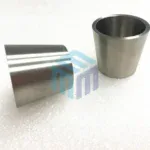
- Cylindrical tungsten crucible
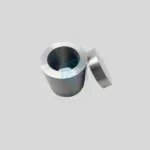
- Tungsten crucible with lid
- Custom-designed tungsten crucible products
- Tungsten boat crucible systems for specialized applications
Because of their superior temperature capability, tungsten crucibles are widely used in advanced crystal growth processes.
Understanding Molybdenum Crucibles
A molybdenum crucible is fabricated from high-purity molybdenum, another widely used refractory metal.
Common options include:
- Cylindrical molybdenum crucible
- Molybdenum crucible with lid
- Molybdenum boat crucible
- Refractory Metal Molybdenum Crucibles
Molybdenum has long been used in crystal growth and vacuum furnace applications because of its reliable performance and cost efficiency.
Comparing Tungsten and Molybdenum for Sapphire Crystal Growth
Maximum Operating Temperature
One of the most significant differences between the two materials is temperature capability.
Tungsten Crucible
Advantages:
- Extremely high melting point
- Excellent strength above 2000°C
- Minimal deformation under prolonged exposure
For large sapphire crystal growth systems operating at extreme temperatures, tungsten often provides superior stability.
Molybdenum Crucible
Advantages:
- Suitable for many sapphire growth applications
- Reliable performance at elevated temperatures
However, molybdenum begins losing strength at temperatures where tungsten continues to perform exceptionally well.
Winner: Tungsten
Resistance to Thermal Deformation
Large sapphire crystals require long growth cycles that may last several days or even weeks.
During these cycles, the crucible must maintain its shape.
Tungsten Crucibles
Offer:
- Outstanding creep resistance
- Excellent dimensional stability
- Reduced distortion during extended processing
Molybdenum Crucibles
Provide:
- Good structural stability
- Reliable performance in moderate crystal growth applications
However, long-term deformation resistance is generally lower than tungsten.
Winner: Tungsten
Thermal Conductivity
Thermal conductivity affects heat transfer and temperature uniformity throughout the crystal growth process.
Molybdenum Crucible
Advantages:
- Higher thermal conductivity
- Faster heat distribution
- Improved thermal management
These characteristics can contribute to more uniform heating in certain furnace designs.
Tungsten Crucible
Still offers excellent thermal performance but generally exhibits lower conductivity than molybdenum.
Winner: Molybdenum
Contamination Control
Purity is critical for sapphire crystal production.
Both tungsten and molybdenum can be manufactured to extremely high purity levels.
However:
- Tungsten generally exhibits lower vapor pressure at extreme temperatures.
- Reduced vaporization can minimize contamination risks during long crystal growth cycles.
Winner: Tungsten
Mechanical Machinability
Complex crystal growth systems sometimes require customized crucible geometries.
Molybdenum
Benefits include:
- Easier machining
- Simpler fabrication
- More economical customization
Tungsten
While highly durable, tungsten is more difficult to machine and manufacture.
Winner: Molybdenum
Cost Considerations
Budget often plays a major role in crucible selection.
Tungsten Crucible Price
Factors influencing Tungsten crucible Price include:
- Material purity
- Crucible size
- Wall thickness
- Manufacturing complexity
Because tungsten is denser and more expensive, initial costs are generally higher.
Molybdenum Crucible Price
A molybdenum crucible typically offers:
- Lower material costs
- Reduced fabrication expenses
- Better affordability for routine applications
Winner: Molybdenum
Choosing the Right Crucible Supplier
Whether selecting a tungsten or molybdenum solution, quality matters.
When evaluating tungsten crucibles suppliers or molybdenum crucible suppliers, consider:
- Material purity certifications
- Manufacturing expertise
- Dimensional accuracy
- Vacuum furnace experience
- Custom fabrication capabilities
- Quality control processes
Reliable suppliers can help ensure consistent crystal growth performance and reduced production risk.
Conclusion: Tungsten vs Molybdenum—Which Is Better?
Both tungsten and molybdenum crucibles play essential roles in sapphire crystal growth technology.
A tungsten crucible offers:
- Higher temperature capability
- Better dimensional stability
- Lower vapor pressure
- Improved contamination control
Meanwhile, a molybdenum crucible provides:
- Lower acquisition cost
- Easier customization
- Excellent thermal conductivity
- Reliable performance for many growth applications
For the most demanding sapphire crystal production environments, tungsten is often the preferred choice. However, molybdenum remains an excellent and cost-effective solution for many crystal growth operations.
The best choice ultimately depends on operating temperature, crystal size, process duration, purity requirements, and budget considerations.
Looking for High-Quality Tungsten and Molybdenum Crucibles?
If you’re searching for trusted tungsten crucibles suppliers, molybdenum crucible suppliers, Cylindrical tungsten crucible, Cylindrical molybdenum crucible, tungsten crucible with lid, molybdenum crucible with lid, or customized refractory metal solutions, M-Kube Enterprise can help.
📞 Call us: +1-732-808-1999
📧 Email: info@mkubeenterprise.com today to discuss your sapphire crystal growth, vacuum furnace, and advanced materials processing requirements.