
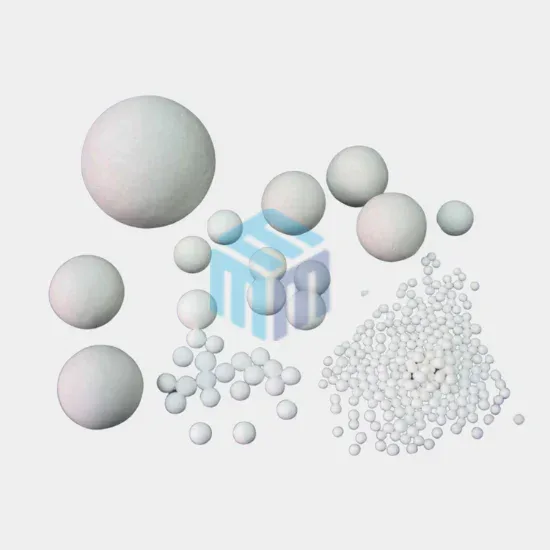
If your milling throughput is falling, particle size is inconsistent, or contamination levels keep rising, the root cause is often low-quality alumina grinding media. Over time, inferior alumina grinding balls lose density, wear unevenly, fracture internally, or introduce impurities into the slurry.
Before you tune your mill, adjust RPM, or change slurry formulation — check the quality of your alumina grinding media, alumina milling balls, and Al₂O₃ grinding beads.
How to Identify Poor-Quality Alumina Grinding Media
A drop in milling efficiency usually shows up slowly at first — then suddenly affects your entire batch output. High-purity Al₂O₃ grinding balls should maintain hardness, shape, and wear resistance over thousands of cycles. When they don’t, you will see these early warning signs.
Visible Surface Wear or Flattened Spots
Low-density or poorly sintered alumina grinding balls develop flat spots, cracks, and micro-pits.
This causes:
- Lower impact force
- Non-uniform grinding
- Excessive heat generation
- Increased batch times
Unexpected Contamination in Your Powder or Slurry
If you notice black, brown, or grey particles in the output, your alumina milling media is shedding material.This typically indicates:
- Low alumina purity
- Presence of binders or silica
- Poor sintering temperature
Contamination is especially damaging for:
- Battery cathode/anode materials
- Advanced ceramics
- Electronic components
- Precision glass polishing compounds
Density Mismatch or Inconsistent Ball Weight
High-quality alumina grinding beads should exhibit uniform bulk density. Density variation leads to:
- Uneven impact force
- Reduced energy transfer
- Lower milling efficiency
You will often notice the beads “separating” during agitation — a classic sign of inconsistent density.
Higher Wear Rate and Frequent Media Replacement
If you are replacing your alumina milling balls faster than usual, the material is not high-grade 92%, 95%, or 99% Al₂O₃.
Common causes include:
- Under-fired ceramic bodies
- Poor microstructure
- Irregular grain bonding
Long-term, this increases operational cost and reduces product consistency.
Frequent Mill Overheating or Higher Energy Consumption
Low-hardness media increases friction, which leads to:
- Higher temperature inside the mill
- More motor load
- Increased energy consumption
Switching to premium Al₂O₃ grinding balls quickly stabilizes energy usage.
Why High-Quality Alumina Grinding Balls Improve Milling Output
Upgrading your alumina ceramic grinding balls directly improves precision, reduces wear, and protects the integrity of your final material.
The right beads maintain consistent grinding action and ensure a controlled particle size distribution.
Higher Purity = Lower Contamination
- 99% Al₂O₃ (or higher) dramatically reduces:
- Metallic contamination
- Slurry discoloration
- Powder degradation
Higher Hardness (Above 9 on Mohs Scale)
- Faster milling
- More efficient impact
- Uniform particle reduction
Optimized Microstructure
Sintered at high temperatures for:
- Better density
- Lower porosity
- Long service life
Stable Wear Pattern
- Predictable batch quality
- Lower media replacement cost
- Reduced downtime
Custom Particle Sizes & Media Shapes
Customized alumina grinding media offers performance advantages for:
- Planetary ball mills
- Attrition mills
- Horizontal mills
- Stirred media mills
When Should You Replace Your Alumina Milling Media?
If you notice any of these problems, replace immediately:
- Surface flattening or cracks
- Irregular ball size or shape
- Visible powder contamination
- Higher energy usage
- Longer milling cycles
Consistent milling begins with consistent quality.
Why Choose M-Kube Enterprise LLC Alumina Grinding Media?
M-Kube Enterprise LLC supplies high-density, high-purity, industrial-grade alumina grinding balls engineered for maximum performance in demanding milling conditions. Our media is produced with controlled microstructure and tested for:
- Uniform density
- Low wear rate
- High temperature stability
- Chemical resistance
Whether you need alumina grinding beads, alumina milling balls, or Al₂O₃ grinding media, we deliver reliable performance for critical applications.
Conclusion
Most milling inefficiencies are not caused by the mill — they are caused by the media inside the mill. Poor-quality alumina grinding media leads to higher wear, contamination, inconsistent particle size, and costly downtime.
Upgrading to premium Al₂O₃ grinding balls restores performance, improves energy efficiency, and ensures consistent, high-purity output across every batch.
If your milling efficiency keeps dropping — start by checking your alumina grinding media quality. Stop productivity losses at the source. Choose premium alumina grinding media backed by M-kube Enterprise LLC for reliable milling results.
References:
1) How to Choose the Right Alumina Grinding Ball for Your Process? (Win-Ceramic)
2) Guide to Alumina Grinding Balls: Properties, Applications, and Selection (Precise Ceramic)
3) Performance and Application of 92 Alumina Grinding Ball (Alumina Ceramic)
4) Processing of alumina grinding media using scandia as a sintering aid (The Americal Ceramic Society)