
Chemical Vapor Deposition (CVD) is one of the most widely used processes in advanced materials research, semiconductor manufacturing, nanotechnology, and thin-film deposition. The success of a CVD process depends heavily on temperature uniformity, gas flow control, reaction environment stability, and equipment configuration.
Among the most important decisions when selecting a tube furnace for CVD applications is choosing between a horizontal tube furnace and a vertical tube furnace. While both configurations are capable of achieving high-temperature processing, each offers unique advantages depending on the application requirements.
Whether you’re operating a research laboratory, pilot production facility, or industrial materials processing operation, understanding the differences between these furnace designs can help improve process efficiency, product quality, and experimental repeatability.
In this guide, we’ll compare horizontal and vertical furnace configurations and explain which option is best suited for various CVD processing applications.
How Furnace Orientation Influences CVD Deposition
In CVD, precursor gases react at elevated temperatures to form thin films or coatings on a substrate surface.
The orientation of the furnace affects:
- Gas flow dynamics
- Particle deposition behavior
- Temperature uniformity
- Sample loading methods
- Contamination risks
- Process scalability
Selecting the wrong furnace configuration can impact coating quality, deposition rates, and process consistency.
This is why furnace orientation is often considered during the early stages of CVD system design.
Horizontal Tube Furnaces for Substrate-Based CVD
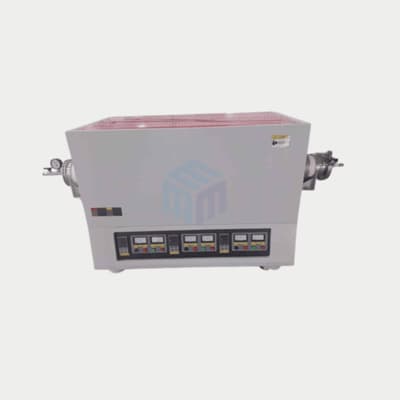
A horizontal tube furnace is the most common configuration used in research laboratories and industrial CVD systems.
In this design, the process tube is positioned parallel to the ground, allowing gases to flow horizontally through the heated zone.
Excellent Process Visibility
Horizontal systems make it easier to:
- Load and unload samples
- Observe sample positioning
- Access reaction zones
- Integrate gas flow systems
Researchers often prefer horizontal furnaces because they simplify experimental setup and maintenance.
Uniform Gas Flow Distribution
For many CVD applications, maintaining consistent gas flow across the substrate surface is critical.
A horizontal furnace supports:
- Stable laminar gas flow
- Consistent precursor distribution
- Improved thin-film uniformity
This makes it highly suitable for:
- Graphene growth
- Carbon nanotube synthesis
- Thin-film deposition
- Semiconductor research
Easier Scale-Up
Many industrial CVD production systems are based on horizontal furnace designs.
Advantages include:
- Larger processing volumes
- Multi-zone heating capabilities
- Better integration with automation systems
For organizations planning future production expansion, horizontal systems often provide a smoother transition from laboratory research to industrial manufacturing.
Read also: Single-Zone vs Multi-Zone Tube Furnace: Which One Suits Your Lab or Industrial Application?
Vertical Tube Furnaces for Powder and Gas-Solid CVD Processes
A vertical tube furnace positions the process tube vertically, with gases flowing upward or downward through the reaction chamber.
This configuration offers several unique benefits.
Reduced Particle Contamination
Gravity naturally helps remove particles from the reaction zone.
This can reduce:
- Dust accumulation
- Particulate contamination
- Unwanted surface defects
For high-purity deposition processes, this can be a significant advantage.
Better Processing of Powders and Bulk Materials
Vertical systems are particularly useful when working with:
- Powders
- Granules
- Catalyst materials
- Bulk feedstocks
The vertical orientation helps maintain material positioning during processing.
Enhanced Gas-Solid Interactions
Certain CVD and reaction processes benefit from upward gas movement through a material bed.
Applications include:
- Catalyst activation
- Nanomaterial synthesis
- Powder coating
- Specialized vapor-phase reactions
For these applications, vertical furnaces can provide more effective gas contact with the processed material.
How CVD Reactor Geometry Affects Deposition Uniformity
Reactor geometry directly influences how evenly precursor gases reach the substrate surface. Tube diameter, heated-zone length, substrate position, gas inlet design, and exhaust location can create differences in gas velocity, temperature distribution, and precursor concentration, which may affect coating thickness and deposition uniformity.
In horizontal reactors, substrates are typically positioned along the heated zone, so their distance from the gas inlet and outlet can influence deposition. Vertical configurations can provide different gas distribution and substrate-loading arrangements, particularly for stacked or suspended substrates.
For consistent CVD results, the reactor should be selected based on substrate size, loading arrangement, gas flow requirements, heated-zone dimensions, and required coating uniformity rather than orientation alone.
Gas Residence Time in Horizontal vs Vertical CVD Reactors
Gas residence time refers to how long precursor gases remain within the heated reaction zone before exiting the reactor. It is influenced by gas flow rate, reactor volume, pressure, temperature, and tube geometry.
A longer residence time can increase precursor exposure but may also promote unwanted gas-phase reactions or particle formation. A shorter residence time can reduce these effects but may provide insufficient time for the desired surface reaction.
Horizontal and vertical configurations can produce different flow paths and residence-time distributions depending on their reactor dimensions and gas-inlet design. Therefore, the correct configuration should be selected according to the precursor chemistry, deposition temperature, pressure, gas flow rate, substrate arrangement, and desired deposition rate.
Horizontal vs Vertical CVD Reactors: Which Process Variables Change?
Temperature Uniformity
Both furnace types can provide excellent temperature control when properly designed.
However:
- Horizontal systems often offer larger uniform heating zones.
- Vertical systems may provide better temperature symmetry around suspended samples.
Sample Handling
Horizontal Tube Furnace
- Easier sample loading
- Better accessibility
- Convenient maintenance
Vertical Tube Furnace
- Requires top or bottom loading
- May need specialized sample holders
- Better for hanging or suspended samples
Gas Flow Characteristics
Horizontal Furnace
- Laminar flow patterns
- Ideal for substrate coating
- Better for thin-film deposition
Vertical Furnace
- Natural convection assistance
- Enhanced gas-solid interactions
- Effective for powder processing
Space Requirements
Vertical furnaces typically require less floor space because they utilize vertical height rather than horizontal length.
This can be advantageous for laboratories with limited bench space.
Horizontal vs Vertical Tube Furnace Comparison for CVD
Horizontal and vertical tube furnaces can both be used for CVD processing, but their geometry affects gas flow, sample positioning, loading method, heat distribution, and process handling. The better configuration depends on the substrate or powder being processed and the required deposition conditions.
| Parameter | Horizontal Tube Furnace | Vertical Tube Furnace |
|---|---|---|
| Process Orientation | Horizontal gas/sample path | Vertical gas/sample path |
| Substrate Processing | Convenient for flat substrates and samples | Suitable for vertically positioned or suspended substrates |
| Powder Processing | Suitable for some batch processes | Often convenient for powder and gas-solid reactions |
| Sample Loading | Generally easy side loading | Typically requires top or bottom loading |
| Gas Flow | Gas travels along the tube | Gas moves upward or downward through the reaction zone |
| Footprint | Requires more horizontal space | Can provide a more compact footprint |
| Sample Positioning | Easy access along the heated zone | Useful for suspended or stacked arrangements |
| Typical Applications | Thin films, graphene, CNTs, substrate coating | Powder processing, catalyst treatment, specialised CVD |
| Process Flexibility | Strong for laboratory substrate experiments | Strong for processes benefiting from vertical material movement |
| Selection Priority | Substrate access and horizontal gas flow | Gravity, sample arrangement, and vertical flow control |
Neither configuration is universally better. Horizontal furnaces are often convenient for substrate-based CVD, while vertical designs can be advantageous for powder processing or applications where gravity and vertical gas flow are useful. Reactor geometry, pressure, precursor chemistry, temperature profile, and sample arrangement should all be considered before selecting a furnace.
How Gas Flow Changes Between Horizontal and Vertical CVD Furnaces
Gas-flow behaviour is an important consideration in CVD because the distribution and movement of precursor gases directly influence reaction rate, deposition uniformity, residence time, and surface coverage.
In a horizontal tube furnace, gases typically enter from one end of the process tube and travel along the heated zone before reaching the exhaust. This configuration can provide a relatively straightforward flow path for substrate-based deposition. Substrate position, gas velocity, tube diameter, and inlet design can affect precursor concentration across the sample.
In a vertical tube furnace, gases generally flow upward or downward through the reaction zone. The vertical arrangement can be useful for powder beds, suspended substrates, or gas-solid reactions where gravity influences material positioning or particle behaviour.
Key gas-flow considerations include:
- Gas velocity: Excessive flow can reduce residence time, while very low flow may affect precursor delivery and process stability.
- Residence time: Determines how long precursor gases remain within the reaction zone.
- Flow distribution: Uneven flow can produce non-uniform deposition across substrates or within powder beds.
- Precursor concentration: Changes in concentration can affect deposition rate and coating thickness.
- Reactor geometry: Tube diameter, length, inlet design, and exhaust position influence the flow profile.
- Pressure: CVD pressure affects gas transport, reaction kinetics, and deposition behaviour.
- Substrate or powder arrangement: The position and geometry of the material can change local gas exposure.
For this reason, furnace orientation should be evaluated together with the gas-delivery system, mass-flow control, reactor geometry, pressure, and process chemistry rather than treated as an isolated design choice.
Substrate Processing vs Powder Processing: Which Furnace Configuration Is Better?
The preferred furnace orientation depends heavily on whether the CVD process involves solid substrates, powders, catalysts, or other material forms. The choice should be based on how the sample needs to be positioned and how precursor gases must interact with it.
| Processing Requirement | Horizontal Furnace | Vertical Furnace |
|---|---|---|
| Flat substrate coating | Often advantageous | Suitable with appropriate holder |
| Graphene/CNT growth | Commonly used | Possible depending on reactor design |
| Thin-film deposition | Often convenient | Application dependent |
| Wafer/substrate research | Convenient sample access | Useful for specialised arrangements |
| Powder processing | Suitable for selected batch designs | Often advantageous |
| Catalyst treatment | Suitable | Often advantageous |
| Gas-solid reactions | Suitable | Can provide useful vertical flow |
| Suspended samples | Less convenient | Often advantageous |
| Easy visual/sample access | Generally convenient | Depends on furnace design |
| Compact laboratory footprint | May require more floor space | Can be more compact |
Ultimately, the best configuration is the one that provides the required temperature uniformity, precursor distribution, sample positioning, gas residence time, and process repeatability for the specific CVD application.
Conclusion: Selecting the Right Furnace Configuration for CVD Success
The choice between a horizontal and vertical tube furnace ultimately depends on your process requirements, material characteristics, and production goals.
Meanwhile, vertical systems offer unique advantages for powder processing, catalyst treatment, and contamination-sensitive applications.
By understanding the strengths of each configuration, laboratories and manufacturers can optimize process performance, improve coating quality, and maximize equipment investment.
As CVD technology continues to advance across semiconductor, energy, aerospace, and nanotechnology industries, selecting the right furnace configuration remains a critical factor in achieving reliable and repeatable results.
Looking for High-Quality Tube Furnaces?
If you’re searching for reliable lab tube furnace, horizontal tube furnace, vertical tube furnace, quartz tube furnace, or high temperature tube furnace solutions for research and industrial applications, M-Kube Enterprise can help.
📞 Call us: +1-732-808-1999
📧 Email: info@mkubeenterprise.com