
Calcination is one of the most critical steps in processing ceramics and minerals. Whether you’re removing volatile components, decomposing carbonates, or preparing powders for sintering, the quality of calcination directly impacts the final material performance.That’s where a muffle furnace becomes essential.
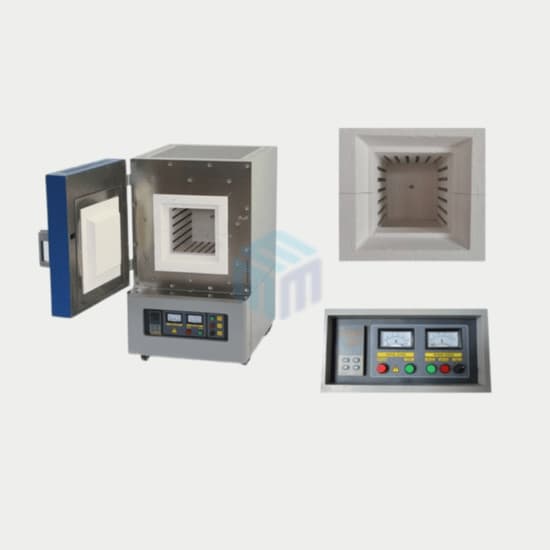
Designed to deliver controlled, uniform, and contamination-free heating, modern muffle furnaces, especially high temperature muffle furnace systems that help laboratories and industries achieve consistent calcination results with precision.
What Is Calcination and Why It Matters
Calcination involves heating a material to high temperatures (typically 800°C to 1600°C) in a controlled environment to:
- Remove moisture and volatile substances
- Decompose carbonates and hydroxides
- Induce phase transformations
- Improve material reactivity
In ceramics and mineral processing, improper calcination can lead to:
- Incomplete reactions
- Poor material density
- Inconsistent grain structure
- Reduced product quality
This is why furnace selection plays such a critical role.
What Makes a Muffle Furnace Ideal for Calcination?
A muffle furnace is specifically designed to isolate the material from direct flame or combustion gases. The heating elements are separated by an insulated chamber (the “muffle”), ensuring clean and uniform heating.
Key Advantages:
- Contamination-free processing
- Uniform temperature distribution
- Accurate temperature control
- Stable heating environment
These features make muffle furnaces ideal for high-purity ceramic and mineral applications.
Uniform Heating for Consistent Calcination
One of the biggest advantages of a high temperature lab furnace is uniform heat distribution.
In calcination:
- Uneven heating leads to incomplete decomposition
- Temperature gradients cause inconsistent phase changes
- Overheating can damage material structure
A well-designed industrial muffle furnace ensures that heat is evenly distributed throughout the chamber, allowing all parts of the sample to undergo the same thermal treatment.
This is especially important when working with:
- Ceramic powders
- Mineral ores
- Catalyst materials
- Advanced oxide ceramics
Temperature Control Across Different Calcination Ranges
Different materials require different calcination temperatures. Muffle furnaces are available in multiple configurations to match these needs:
- Muffle furnace 1000°C → Suitable for basic drying and low-temperature decomposition
- Muffle furnace 1200°C → Common for general ceramic processing
- Muffle furnace 1400°C → Used for advanced oxide ceramics
- Muffle furnace 1600°C → Required for high-performance materials and research
Precise control ensures that reactions occur at the correct temperature without overheating or under processing.
Role of Controlled Atmosphere in Calcination
Some materials are sensitive to oxygen levels. In such cases, a controlled atmosphere muffle furnace becomes critical.
It allows:
- Inert gas environments (argon, nitrogen)
- Reduction or oxidation control
- Prevention of unwanted chemical reactions
Controlled atmospheres ensure that calcination produces the desired chemical phase without contamination.
Industrial Muffle Furnaces
Designed for:
- Continuous or large-scale processing
- High throughput production
- Consistent batch performance
An industrial muffle furnace ensures repeatability across production cycles, which is critical for commercial operations.
Choosing the Right Muffle Furnace
Selecting the right furnace depends on:
- Maximum operating temperature
- Chamber size
- Heating rate
- Atmosphere control requirements
- Sample type and volume
While many buyers compare muffle furnace price, long-term performance depends more on temperature uniformity, insulation quality, and control system accuracy.
Conclusion: Precision Calcination Starts with the Right Furnace
Calcination is more than just heating—it’s a controlled transformation that defines the final properties of ceramics and minerals.
A well-designed muffle furnace provides:
- Clean heating conditions
- Accurate temperature control
- Uniform heat distribution
- Reliable and repeatable results
Whether you’re working in a research lab or an industrial facility, the right furnace ensures consistent calcination and better material performance.
Looking for a High-Performance Muffle Furnace?
If you’re evaluating a high temperature muffle furnace, industrial muffle furnace, or a controlled atmosphere muffle furnace for your application, we’re here to help.
📞 Call us: +1-732-808-1999
📧 Email: info@mkubeenterprise.com
today to find the right furnace solution for your ceramic or mineral calcination process.